What does my licence mean?
- Gab Crawford
- May 23, 2019
- 5 min read
Updated: Nov 13, 2022
You've got your licence in the post and it looks a bit different than the 'credit card' style CAA licence in your wallet or maybe this is your first time seeing one! For those who don't have one and are curious, it comes as a set of approximately 5 x A4 pages, they're designed to be split into 4, many people buy a 'licence wallet' to stop the documents getting damaged - it is paper after all! As well as their licence they put their medical in this wallet and it must go with you everywhere you fly - It is a legal requirement and CASA are known to check at any time, nowadays 'e copies' are acceptable! I've decided to upload an old licence of mine to help people follow what I'm talking about - a lot has changed in my career since this licence was printed so it's virtually useless!
Let's interpret it together! I'm going to go through it all page by page to KIS - Keep it Simple! First off, for those who maybe did their conversion a while ago, the first thing you need to check is that you have a Part 61 licence! It's very easy to check, just look at the front page. Australia used to have a licence system like NZ, however that all changed in 1998, but that's a topic for later!

So after checking your front page, the next page is just your details, the only thing you really need to take from this is your ARN - you will use it for everything soon! And don't forget to sign it.

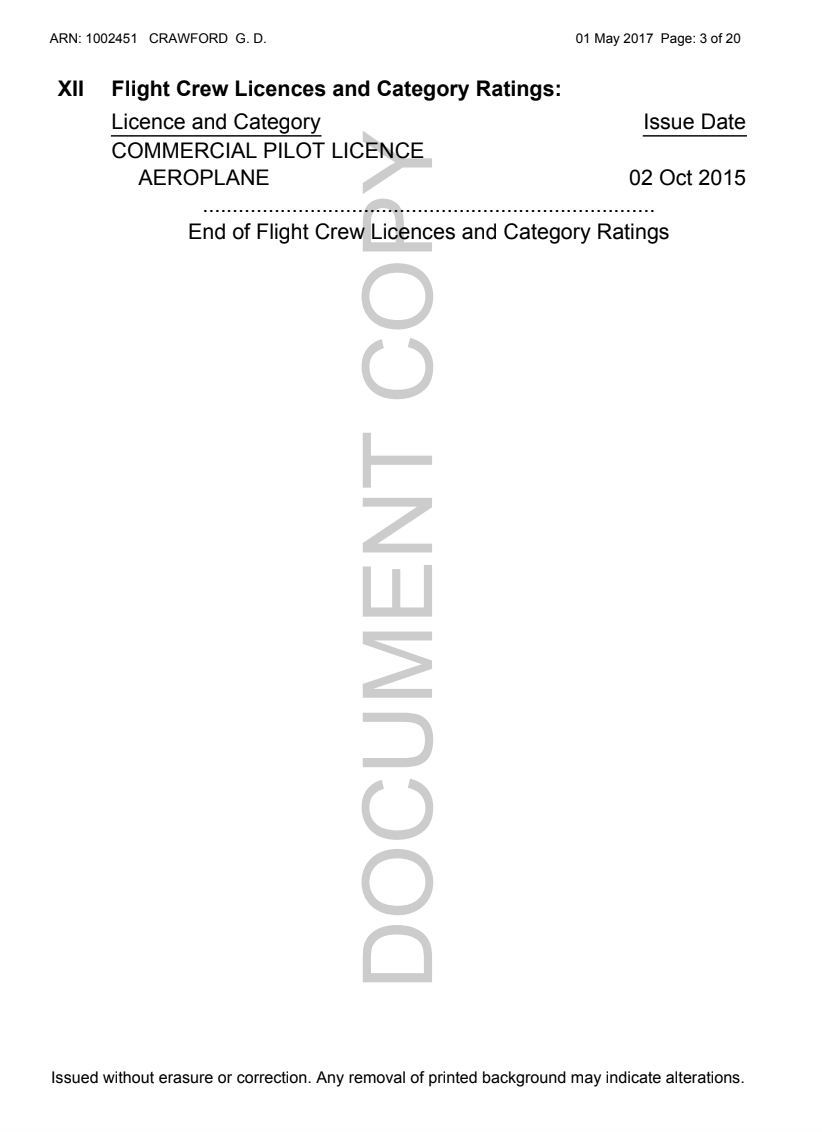
Page three again is pretty straight forward, it just tells you that you're a CPL with either a Helicopter or Aeroplane Pilot or both. You could also have things like Gyros or Airships - see the glossary at the end.
Ok so now we're getting into the bit that trips up a lot of us Kiwi's, the Ratings and Endorsements page. The Class Rating system is fairly straight forward; SEA - Single Engine Aeroplane MEA - Multi Engine Aeroplane Now, Australia does not have type rating like we do. As far as CASA is concerned if you can fly a C172, you can fly a C152, C182, C206, C207, C210 - provided you have the Design Features applicable to the aircraft endorsed on your licence. Look at the picture down below, under Design Feature Endorsements, (DFE) I have MPPC and RU. MPPC means Manual Pitch Propellor Control - it's a CSU (Constant Speed Unit), RU means Retractable Undercarriage. With these 2 key design features I can fly most single engine piston aircraft unless they have something like a tailwheel gear or floats attached However what if I didn't have MPPC? Let's look at the list of Cessna's above, if I didn't have MPPC, I can't fly any of the a/c that have a CSU - so my options become fairly limited. I would only be able to fly the C152 and C172. Let's say now that I do have MPPC but no RU - my options become much more open, with me being able to fly all the aircraft listed above apart from the C210 or the C182 if it was an RG model. To a lot of people reading this I'm sure you're thinking that clearly having the MPPC is much more important than the RU, that would be true if this system was in NZ! However with Australia being such a large country, the a/c with retractable undercarriages reign supreme here due to the extra speed! A lot of pilots will start on a C210 or Piper Lance, but of course there are a few fixed gear jobs around to start. A quick note, currency is almost the same here as in NZ, 3 take-off and landings in 90 days, but 3 circuits in a C172 would also count as currency for a C206, and all other single engine aircraft - How good! Obviously a bit of common sense should come into play here, if you are stepping into a new aircraft, just because you have the DFE, doesn't mean you should take yourself and a few mates for a joy ride, same goes for currency, consider what your experience level is, your experience on that particular aircraft, and your recency then decide to take yourselves to the skies or grab an instructor! Another quick note, 3 take off and landings will not get you current in a Multi Engine Aircraft if your MEA Flight Review isn't current - this lasts 2 years, just like a BFR in NZ and works on the same principle as a BFR. Quite simply, to fly as PIC of a Multi Engine a/c you must have a current flight review on a MEA, and of course keep up with recency requirements every 90 days. And yes there are SEA flight reviews too!

After that lengthy topic, next page! Operational Ratings and Endorsements
This is where you'll find things such as your Instrument, Flight Instructor or Examiner Rating.
From the top we'll start with Instrument Rating.
MEA or SEA tell you whether you have a Single Engine or Multi Engine I.R - easy! IAP 3D - Instrument Approach 3 dimensional, an ILS essentially. An aid that provides both vertical and lateral navigation guidance, that's where the 3D part comes from. IAP 2D - Instrument Approach 2 dimensional, VOR, RNAV etc. An aid that uses lateral guidance only.
Flight instructor ratings. I can teach; Spin NVFR - Aeroplane
and I'm a Grade 3 - Aeroplane
In Australia, instead of A, B or C cat., you're either a Grade 1, 2 or 3. They are different but that's a topic for another day. The night part is a very grey area for a Grade 3 instructor, people tell me I am extremely lucky to have it on my licence. It is likely your licence - if you have the endorsement - will come with 'Night - restricted to the Circuit Only'. I had this removed, but I fought for it. Night Instruction for a grade 3 is a finicky topic, and is one I will not be getting into. If you end up working as an instructor in Australia, your company will help you out with understanding what you can and can't do with your night privileges with regards to instruction.
For those with Aerobatics instruction attached to their CAA licence, unfortunately no matter how hard you try, you won't get this added to your licence as CASA doesn't recognise it as an 'official endorsement', I even had the CAA write to CASA to explain that I have the appropriate qualifications, but to no success, suck it up and move on I'm afraid. With flight activity endorsements, aerobatics proves the same nightmare, yet I can go up and do spinning? A bit odd if you ask me but oh well!

Page 6 and 7 are blank for me personally. We're almost at the end, many of your last pages will look something like the image below. Treat this like the front of your CAA logbook, this is where your examiner will write your flight reviews, instrument renewals (called an IPC - Instrument Proficiency Check), and so on. You don't need to do anything but make sure your examiner signs the line.

And on the last few pages, you will have a glossary. Essentially match the title of each section in the glossary to a title in your licence to find out what you could potentially get or to understand what you already have.


I hope this guide helps you to make sense of your new licence, essentially it's like a logbook supplement. In NZ you put everything in your logbook, here they put everything on your licence.
Lastly, https://www.legislation.gov.au/Details/F2022C00697/Html/Volume_2#_Toc100063764
if you want to understand anything in the Australian licensing system I recommend checking out this link - make sure you click 'go to latest' to make sure you are reading the current version. Take a moment to read through all the sections regarding licensing. Any questions, please ask! Gab


Comments